Mastering Document Automation
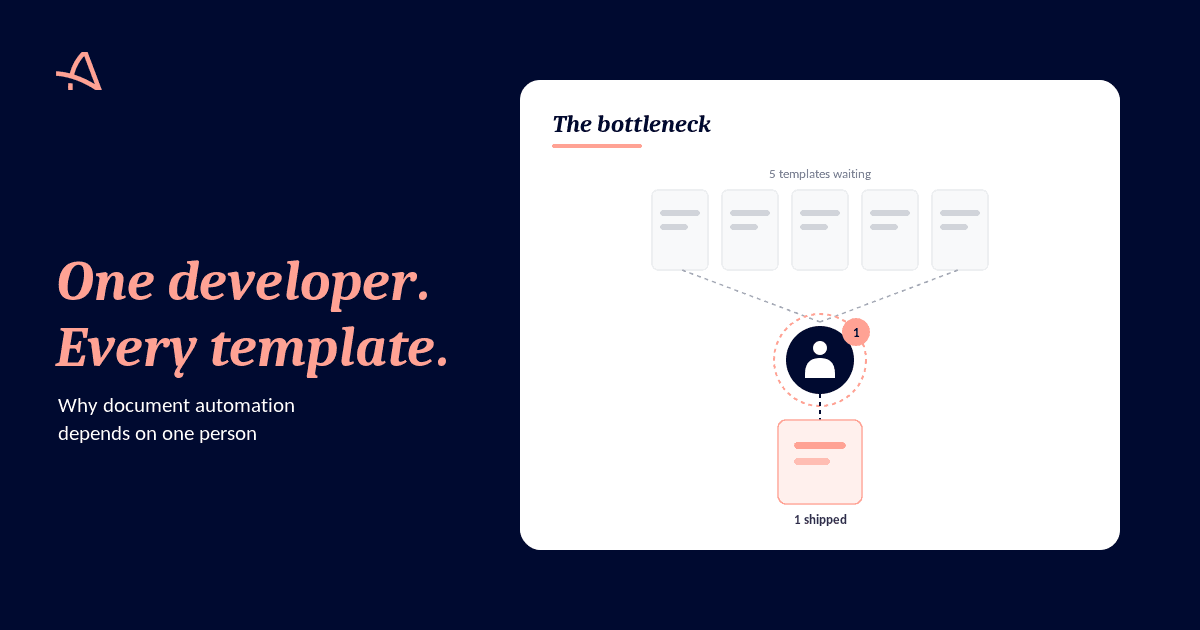
Ask a firm what’s holding back its document automation program, and the honest answer is rarely the software. Most firms are already sitting on software that’s more capable than what they’re using it for. What’s holding the program back is that template-building lives with one person.
While that person is busy, the queue grows. When they leave, the program stops.
A head of technology at one firm called it having “one guy who basically sits and builds these documents all day.“
Whether document automation for law firms scales isn’t a technical question. It’s an organisational one. Can someone without a coding background build and change a template themselves? If yes, that alone means template work that used to take months now takes days – and it stops routing through a single desk.
Why does legal document automation software stay dependent on one developer?
Most legal document automation software is built around one person coding the logic behind each template. That’s not a flaw in the platform. It’s a design choice, and it quietly recreates the same bottleneck: one developer who authors everything, and a queue that grows the moment they’re unavailable.
One developer becomes irreplaceable as they’re the only person who can author new templates, modify existing ones, or adapt automation to a new practice area. Three consequences follow:
The capacity trap: Your best developer is already at capacity, so document workflow automation moves only as fast as their time allows.
The turnover risk: When that person leaves, the firm is left with templates it can’t modify and no clear way to rebuild them.
The scalability ceiling: With one author, your legal document automation software scales only as far as that person can reach. A new practice area means a new queue.
How does legal knowledge management change the equation?
Legal knowledge management is the discipline of capturing what your best lawyers already know – clause variations, jurisdictional quirks, precedent logic – so it doesn’t live in one person’s head or one developer’s code. Document automation software is only as good as the knowledge behind it, which is why firms that scale treat authoring as a knowledge management problem, not an IT one.
Firms with a mature law firm knowledge management function are already sitting on this knowledge – it’s been locked out of the templates because the tooling required a developer to translate it into logic. Legal knowledge management software that lets a Professional Support Lawyer (PSL) or knowledge lawyer author directly removes that translation step. The knowledge and the template-building become the same job, done by the same person, at the same time.
Fixing the bottleneck with no-code automation
Firms that scale document automation move authoring to non-developers first: knowledge lawyers and operations teams who already know the practice area. Once someone without a coding background can build and update a template through no-code automation, three things change.
Template authors multiply: You’re no longer bottlenecked by one person’s calendar.
Changes get faster: A template update doesn’t require a developer ticket and a two-week wait – it happens in the afternoon.
The program stays aligned: As the practice evolves, the templates evolve with it, because the people maintaining them are the people who see the work changing.
One firm proved it with a single high-use template where the build replaced a manual process on a live deal and saved six hours. Six practice groups saw it work and adopted the program. The shift wasn’t technical – it was about who owned authoring.
Document assembly software caps out at what one developer has time to build. In a knowledge lawyer’s hands, it caps out at what the practice actually needs – a much higher ceiling.
FAQs
What is document automation?
How do you automate document creation?
Who should own document automation at a law firm?
Take the virtual walkthrough
See it instead of taking our word for it. Our virtual walkthrough puts you inside the automation platform — watch a knowledge lawyer build and update a template live, with no code and no developer queue.
Self-guided. No sales call. Takes 3 minutes.