
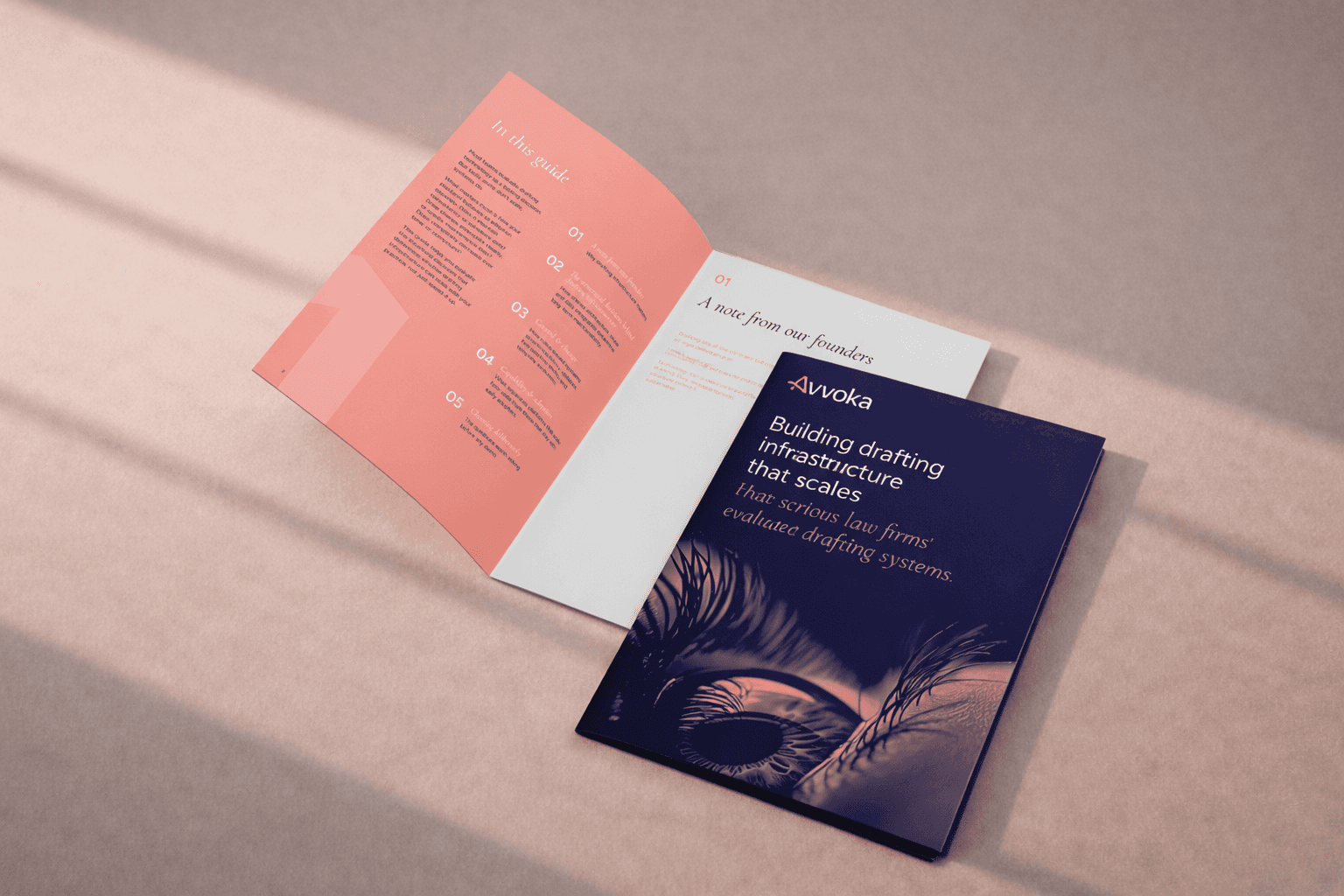
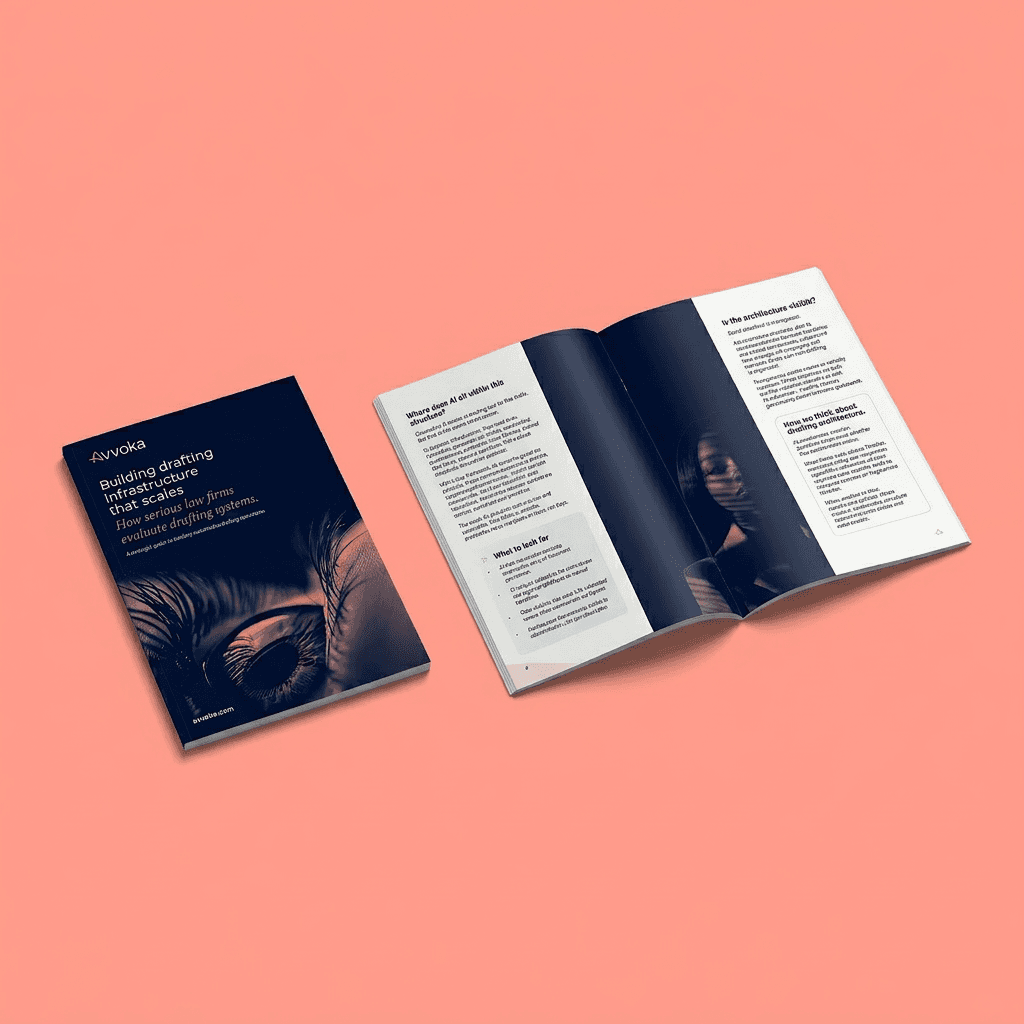
Free strategic guide · 18 pages · vendor-agnostic
The drafting platform buyer's guide.





Leaving a legacy drafting tool?
You are migrating from HotDocs, Contract Express, PatternBuilder or DocAssemble. You know what the next platform needs to handle, and what cannot get lost in the move.
Moving past single-developer dependency?
One developer builds every template. The queue never gets shorter. When they leave, the whole library goes with them. You want to hand authoring to a wider team without losing control.
Scaling beyond single-document GenAI?
GenAI can draft a contract. What it can't do is produce the engagement letter, the NDA and the SoW from the same input, with consistent data and conditional logic. That's what document automation is actually for.
Inside the guide
Four chapters. One framework.
Here is what we cover, and where each chapter sits in the full PDF. Read the previews below, then grab the full 18 pages.
01
Architecture: the decisions you cannot fix later
p.4
02
Control and change: keeping templates current without breaking them
p.8
03
Capability and adoption: what lawyers will actually use
p.14
04
Choosing deliberately: the questions to ask any vendor
p.18
Preview · Chapter 01
The architecture you pick today sets the ceiling for the next three years.
Before you compare features, look at how templates are built, where variables live, who can author them, and how documents come together. These are the decisions you cannot easily reverse later.
From the guide
"It is easy to compare features in a demo. Architecture is what you feel on day 300, when the library has grown and a small change suddenly touches fifty templates."
"Architecture is the part of procurement you do not notice until it hurts. By then you are two years in and it is expensive to fix."
✚ What the chapter covers
• Who gets to author templates: developers only, or lawyers too.
• Where variables live, and how they flow between templates.
• Whether you produce one contract, or full suites from one input.
• Cloud vs. self-hosted, and what that means for infosec.
Preview · Chapter 02
Your templates are going to change. The real test is how gracefully the platform lets them.
New precedents, new clauses, new jurisdictions, new regulators. Your templates will need to keep up. The question is whether they can, without quietly breaking what is already live.
From the guide
"At ten documents a month, small variations are fine. At hundreds, those little inconsistencies start to show up in places you really do not want them."
"The benefit of a rules-based system is that you make the change once, in one place, and it carries through every document that depends on it."
✚ What the chapter covers
• Version control: how updates cascade through a live template library.
• Clause libraries: shared logic, approved language, and what breaks at scale.
• Workflow & approvals: routing, comments, and compliance sign-off.
• Audit trails: who changed what, when, and why, at both document and template level.
Preview · Chapter 03
The best platform is the one lawyers actually pick up.
Most buyers' guides focus on features. The question that actually matters, by month six, is whether your lawyers are using the thing. Platforms chosen by ops and quietly dropped by fee earners are the most expensive failure mode in legal tech.
From the guide
"If the first useful template takes three weeks to build, no training programme in the world is going to save the rollout."
✚ What the chapter covers
• What a lawyer can do on day one, and where they get to by day 90.
• Whether authoring feels like editing Word, or writing code.
• Pilot team first, or firm-wide from day one.
• What vendor support looks like after the contract is signed.
Preview · Chapter 04
The questions to ask any vendor, including us.
Chapter four is a vendor-neutral checklist. Take it into every demo you run. If a vendor struggles to answer any of these cleanly, pay attention.
From the guide
"Most vendors can run a good demo. The useful test is which ones will put the same answers in writing, or let you hold them to it in the contract."
"Ask every vendor how the contract ends, and how you get your templates and data back when it does. The quality of that answer tells you more than any part of the pitch."
✚ What the chapter covers
• Whether you pay per seat, per document, or per platform, and how that scales.
• The difference between a two-week PoC and a six-month programme.
• Hosting, data residency, SOC 2, and everything else infosec will want to see.
• Whether you can leave with your templates and your data when you want to.
The drafting platform buyer's guide
Get the guide.
18 pages. Vendor-agnostic. Delivered to your inbox.